Ad Barbellum
Table of Contents
Taleb’s barbell strategy is a gym-inspired metaphor. A gym is maybe the single most Mediocristan environment ever engineered. This has been making me laugh for a year and nobody seems to notice the absurdity.
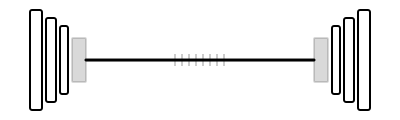
Consider what a barbell actually is. A rigid steel bar with standardized weight plates mounted symmetrically on each end. Every property is a deliberate engineering effort to eliminate wild variance. Fixed increments. Perfect bilateral symmetry. A straight shaft that distributes load evenly across its length. The entire design philosophy is: take raw, chaotic mass and make it Gaussian. Manageable. Domesticated.
And the environment it lives in — the gym — is a room built so that exposure to force cannot cascade into fat-tailed outcomes. Rubber floors. Spotters. Climate control. Liability insurance. Weights in labeled, standardized increments from 2.5 to 45 pounds. A temple of iatrogenics-avoidance through total environmental control. The closest thing modernity has produced to a padded room where you can safely pretend you’re encountering physical chaos.
Taleb — whose entire intellectual project is “the real world has fat tails, stop pretending you can domesticate uncertainty” — named his core heuristic after the flagship artifact of a facility whose entire purpose is domesticating physical uncertainty into neat, controllable, incremental, Gaussian loading.
That’s layer one. It gets better.
The wrong ratio #
A barbell is defined by bilateral symmetry. Equal weight on both ends. That’s what makes it a barbell and not a mace or a hammer or a medieval flail. Remove the symmetry and the object stops being the thing he named it after.
Taleb’s own prescription: 85–90% in the safest possible assets, 10–15% in maximally speculative positions. That’s not a barbell. That’s a hammer. Or a lollipop.
Every rigorous framework addressing the same bimodal structure arrives at the same shape.
Kelly Criterion — optimal bet sizing under uncertainty. The Kelly fraction is almost always a small percentage of your bankroll. Standard practice is half-Kelly or quarter-Kelly because even full Kelly is too volatile. The speculative end is tiny by mathematical prescription.
Biological mutation rates — the deepest implementation of explore/exploit on Earth. Something like one error per billion base pairs per generation. The conservative end isn’t 50%. It’s 99.9999999%. Organisms that “balanced the barbell” equally — 50% fidelity, 50% mutation — are called extinct.
Epsilon-greedy exploration in reinforcement learning. Epsilon starts small and decays toward zero. Typical values: 1–10% exploration, shrinking.
Information-theoretic, biological, computational — the prescribed ratio is always radically lopsided. 90/10 at the aggressive end, often 99/1 or beyond. The barbell doesn’t just miss this. It smuggles in the one ratio — 50/50 — that every framework agrees will kill you.
There’s a Goodhart’s Law thing hiding here too. If someone takes “barbell-shaped” as their optimization target, they arrive at equal weight on both ends. The maximally dominated position in Taleb’s own framework. He wrote about this exact failure mode. Extensively.
Metaphors we lift by #
Lakoff and Johnson’s Metaphors We Live By is about one thing: metaphors aren’t decorative. They’re structural. The metaphor you choose doesn’t label the concept — it constrains how you think about it, which parts you notice, which parts disappear.
“Argument is war.” Once you have that metaphor, you attack positions, defend claims, shoot down objections. You don’t dance with an argument or build one together, even though those are perfectly coherent things to do with a disagreement. The metaphor forecloses them before you get there.
“The barbell strategy” does the same thing. Once the image is loaded, you think: two ends, balanced, controlled increments, gym environment. The symmetry is baked into every visualization. The rubber-floored safety is baked in. The Gaussian loading is baked in. Not because anyone decided these properties should transfer, but because that’s what the word barbell drags with it whether you want it or not.
Taleb’s whole thing is tinkering. Bricolage. Convex experimentation. Poke at things, see what breaks, learn from the breaking. But nobody tinkers with the barbell. Nobody asks what the clips represent, or what happens when you change grip width, or what the rack means. The metaphor just sits there, inert. A static label bolted to a living idea — from the guy who says static labels are how you get killed.
And it’s load-bearing in the wrong direction. The word pushes you toward 50/50 while the math pushes you toward 90/10. People who internalize the barbell image have to actively fight it to get the ratio right. That’s not a labeling problem. That’s a cognitive one.
None of this touches the idea itself. Bimodal exposure, convex payoff, hollow middle — one of the more useful mental models in circulation. The math is sound. The applications are real. It’s just that the metaphor is wrong in every structural dimension while remaining intuitively satisfying, which is the kind of thing Taleb would find very funny if it were someone else’s metaphor.
P.S. — Apply the barbell strategy to reading. Only tweets and short posts on one end. On the other: Infinite Jest, Knuth’s The Art of Computer Programming, Gibbon’s Decline and Fall of the Roman Empire. Nothing in the middle. No 200-page airport books.
The barbell is crushing Taleb’s chest and he named the exercise.